
This National Tree week, here’s a beautiful and deeply personal account of what planting a tree in our Celebration Wood means to one of our valued supporters (and our Writer in Residence) Joanna Clare Dobson.
As a trigger warning, this post refers to child death.
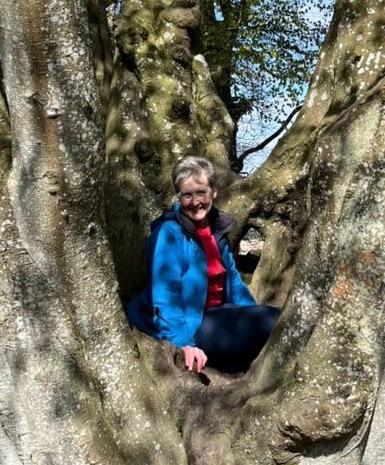
When I was a child my favourite tree was the Copper Beech that grew beside our front gate. Someone had once tied a thick, knotted rope to its lowest branch and as I grew, I taught myself to shin up that rope, heave myself into the crook between branch and trunk, and perch there for as long as my backside could bear the discomfort. I felt like a squirrel. Or sometimes a spy, peering through the damson-coloured leaves to my family coming and going a couple of metres below.
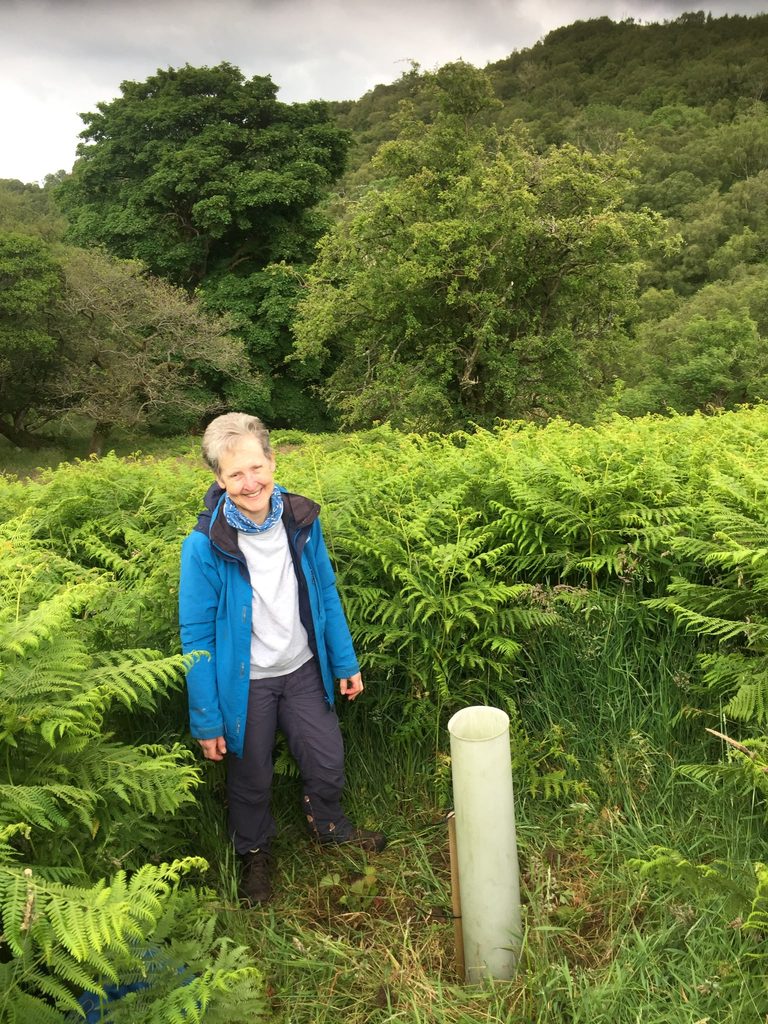
Fast forward a few decades and now my favourite tree is a young Sessile Oak in Celebration Wood. I planted it with my partner and our three children in memory of my brother, Simon, who died in an accident on the road beside the house with the Copper Beech. He was seven and I was ten.
It was 1971 and my family didn’t speak of him until after my father died, 44 years later in 2015. For a long time I didn’t even know where Simon was buried. There were no photos of him in our home and we had no rituals of remembrance. His birthday passed each year without comment.
Almost as soon as my father died, my mother began to talk about Simon. She framed some photographs and arranged them on the mantelpiece. Slowly I realised that I could now allow my little brother back into my life and suddenly it seemed urgent for my sister Helen and I to create our own memorial to him.
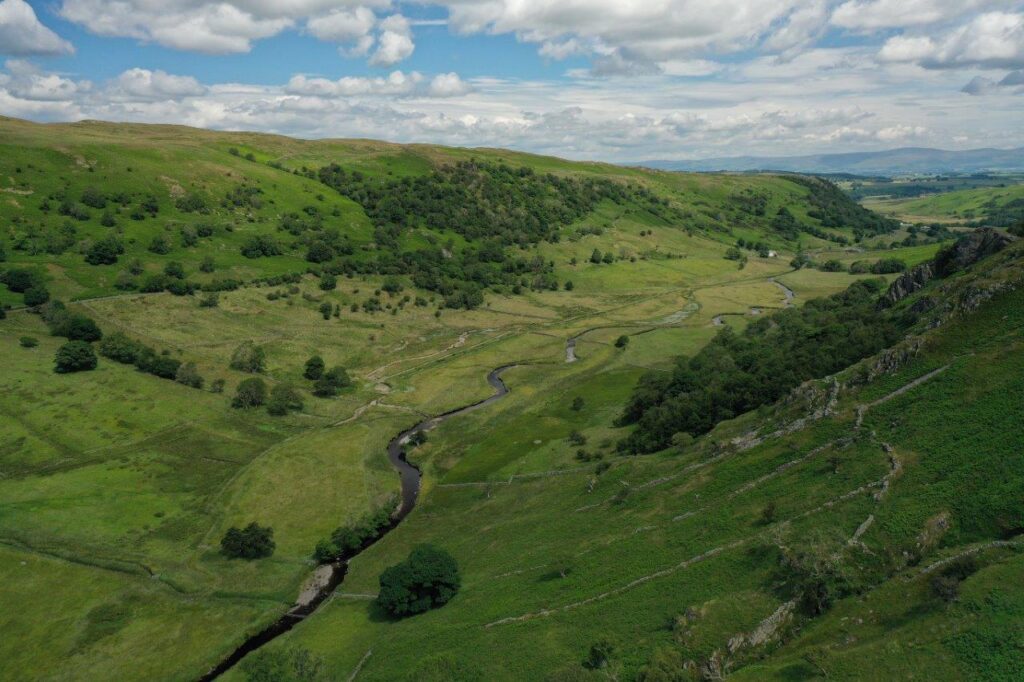
As soon as I heard about the RSPB’s Celebration Wood at Wild Haweswater, I knew it was what I’d been looking for. My family loved the Lake District and we’d spent many happy holidays there while I was growing up. In fact it was the only place where I could be sure I’d see my father smile. When I told Helen about the wood, and that Naddle Beck ran along the bottom of it, she said, ‘Oh Simon would have loved it there.’ Immediately I pictured him charging around the site, splashing in the stream, and collecting treasures from the fragment of temperate rainforest that borders its western edge.
When we planted Simon’s tree, it was a gloriously sunny day at the end of March. We were accompanied by Bea Normington, who manages this part of the Wild Haweswater project, and whose careful, loving attention to it was immediately obvious. We all took turns at digging the planting hole and before long my son Benjamin turned up a small, pale bulb.
‘The only thing that can be,’ said Bea, ‘is a Bluebell.’ She explained how the Bracken everywhere was a sign the area had been woodland in the past, and that Bluebells would have grown there in profusion. However, heavy grazing meant that every single shoot got nibbled off as soon as it appeared. Now there’s a high fence round the site to exclude sheep and deer and the flowers are beginning to bloom again.
‘I call them resurrection plants,’ she said.
I’ve visited Simon’s tree in the spring and there are indeed Bluebells springing up around it, along with orchids, scabious and Water Avens, to name just a few. And as the flowers return, so does so much else – butterflies are increasing, and an amazing variety of other insects, and in spring the forest is full of birdsong.
Bea also told us that the aim of Celebration Wood was to link the fragment of temperate rainforest along its edge with the larger section on the other side of the stream. ‘What we want to do,’ she said, ‘is to get the wood to cross the river.’ In many ancient mythologies, it’s necessary to cross a river to get to the afterlife: the river marks the boundary between life and death. Celebration Wood, however, will cross the river to link life to life.
Trees have so much to offer humans. When I look back at my childhood, I can see that I was drawn to the Copper Beech because it was rooted. Someone I loved had gone out of our front gate and never come back and I lived in terror of it happening again. The Copper Beech could be relied on to remain stable and still.
By contrast, Simon’s tree speaks to me of dynamism and connection. While I was growing up, Simon was frozen in time, an unspeakable event in the past. Now that I’ve processed what happened back then, and had the opportunity to plant the Sessile Oak for him, he’s become a person again – although still, of course, one who was taken from us far too early. I’m connected to him once more, and I’m connected to the other humans who’ve planted trees in Celebration Wood too. More than that, I also feel a sense of belonging to the vast, more-than-human community that makes up the astonishing biodiversity of temperate rainforest.
Simon’s tree, and all these connections, will continue to grow long after I’m gone. And when I do go, I hope my children might plant a tree for me in Celebration Wood too.
Whether in memory of a life, or to mark a special occasion, every tree in Celebration Wood has a story.
Find out more here.
Images: (1) Jo Dobson in a tree in Scotland, (2) Jo with Simon’s tree in Celebration Wood
Blog written by Joanna Clare Dobson in October 2026. Posted by Annabel Rushton, RSPB People and Partnerships Manager for Wild Haweswater on Tuesday 24 November 2026.